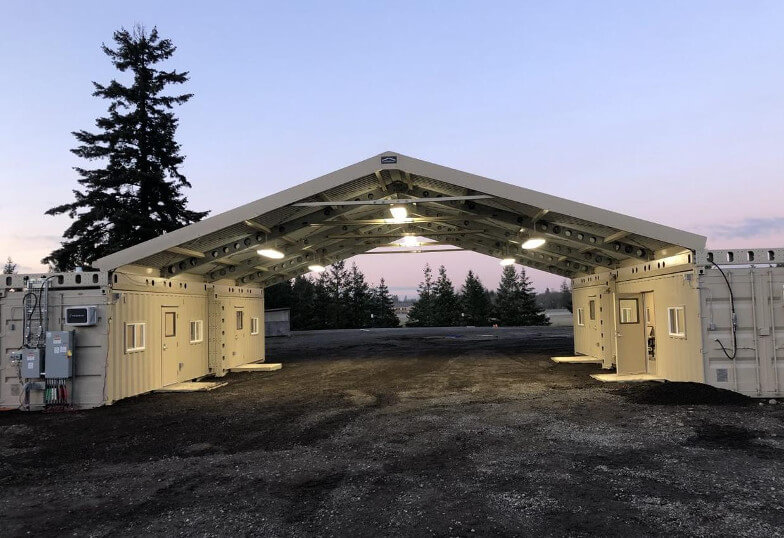
40ft Shipping container office conversion
Converting a full-size 40ft shipping container into an office space is time-consuming, but the results are worth it. Because this office is portable and can be set up almost anywhere, all it needs is a power line.
-
✓
Complete insulation.
-
✓
Two steel entry doors with windows.
-
✓
Five full-size glass windows.
-
✓
Two air conditioners.
-
✓
Four baseboard heaters.
-
✓
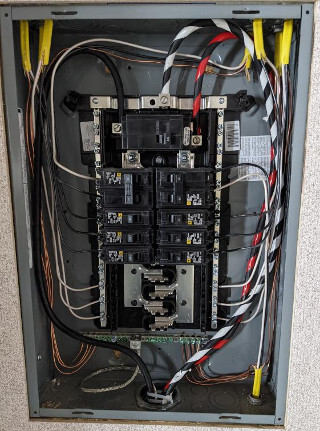
100-amp main electrical panel.
-
✓
Internal LED lights.
-
✓
Inside and outside electrical outlets.
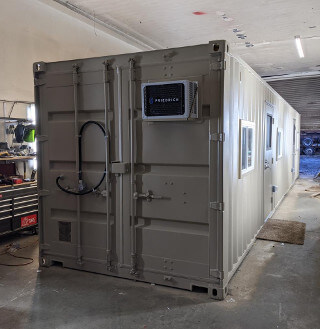
Converting Shipping Container To An Office
Describing how to convert a shipping container into an office in detail would be lengthy and probably boring.
So we will go over the main and major steps in this conversion and the rest will be simple and easy with a little common sense.
The same thing will go for the tools and supplies needed for this conversion.
-
✓
Grinder & cutting wheels.
-
✓
Welding machine.
-
✓
Sealant & Liquid nails.
-
✓
Wrenches, Sockets & Hand tools.
-
✓
Drill, Saw & Impact driver.
-
✓
Electrical hand tools.
-
✓
Weld-N-Go man door kits.
-
✓
Weld-N-Go window kits.
Shipping container office steel work
We start with the steel work to get it out of our way as we have a lot of work ahead of us.
The entry doors and windows are Weld-N-Go kits which make them easy to install.
In this job we are building two 40ft shipping container offices each will have five windows and two man doors which means a total of ten windows and four doors. Now it's a good idea to take the time to build a window frame stand.
The window frame stand will help in holding the frame against the wall while tracing the outline on the walls and at the same time all the windows will be at the same height.
Even though there is a lot of steel cutting for the windows, doors and air conditioners, we did not use the plasma cutter to keep the openings as clean as possible.
Installing the window frames is as easy as trace,cut, clean, weld and seal. The only thing to pay attention to is welding the frames to the shipping container all the way around, not to skip weld.
We ordered the Weld-N-Go man door kits for this job to speed up the process of the build. These metal doors come already inside a steel frame with the hinges attached.
We lined up the door assembly against the wall from the inside of the container and trace the frame to the wall.
Using a cutting wheel on a grinder we cut the door opening and with a grinding wheel we cleaned up the bottom rail flange and the edge of the opening getting it ready for welding.
Now the door assembly can be set inside the opening, lined up with the outside of the shipping container walls tack welded first then welded all the way around just like the window frames.
The entry doors that the customer requested comes with an opening for a small window and the window which will be installed later on.
The air conditioners that we received for this shipping container office mod were wall or window mounted and could not be installed as-is on a shipping container, so we had to fabricate frames for them and some outside support to hold their weight.
The AC frames were built from 2 x 3 inch rectangular steel tubing to match the door frames and the window frames. This will help us later on when we start framing the inside with 2 x 4 inch wood studs for the insulation.
The AC supports were built from 0.5 x 1 inch rectangular steel tubing and a couple of one inch steel flat bars.
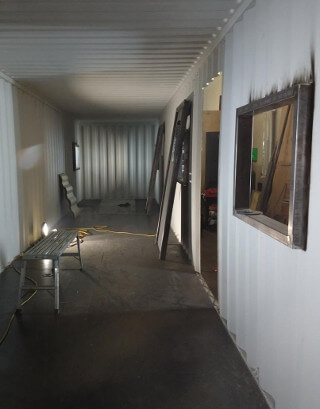
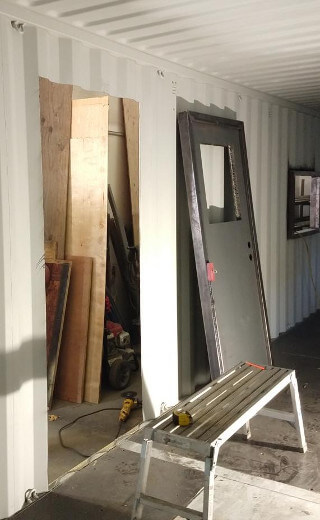
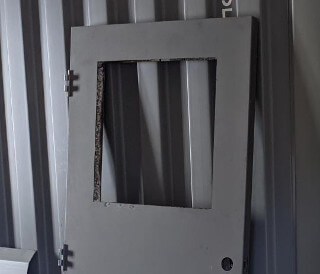
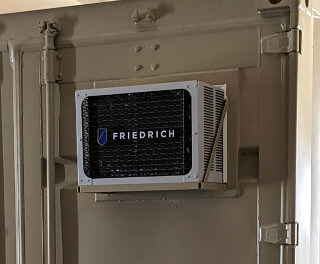
The inside framing was done with 2 x 4 inch wood studs. We ordered 10 and 8-foot lengths.
We start by fastening full-length 10-foot studs face out to the top rails all around the inside of the shipping container using 5/16-inch self-tapping countersunk screws.
Then we attached 1 x 1 inch wood studs to the two by fours with a nail gun, which gives us two flat surfaces for attaching the OSB panels later. Now we can attach the horizontal ceiling 2 x 4 to the one-by-one we just installed.
A one by one inch stud gets nailed to the floor decking all around the container. This will be the bottom base for the vertical studs which will be cut down to length and spaced out 48 inches center to center.
You might get tempted to cut all the vertical studs at once to the same length. That will be a big mistake as the height of the container changes as you get to the center of it.
The back of the shipping container "By the cargo swing doors" get framed too. A wall will cover the opening and the cargo doors will be sealed. Not usable anymore.
By the time the framing is done it will be a good idea to start installing the electrical outlet boxes and wiring.
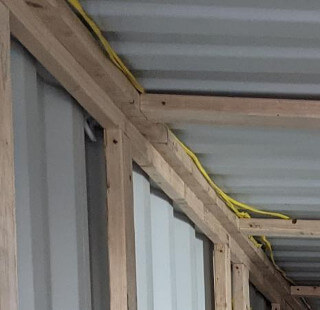
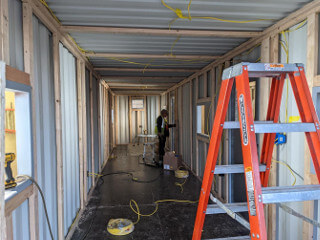
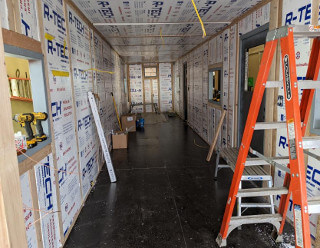
We used insulating sheathing to fill all the voids. Starting with the ceiling then the sides. The insulating Sheathing can be cut with a box cutter, a hand saw or a foam cutter.
If the frame spacing comes out perfect a foam cutter will save a lot of time as you can cut 10 sheets of foam to size at the same time. Unfortunately our foam cutter quit on us so we had to use a hand saw while the new cutter is on its way.
There was no need to glue any of the insulation sheathing as all the cuts were done with a hand saw and they all turned out nicely with a tight fit.
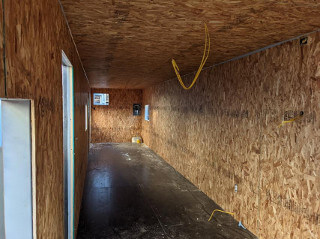
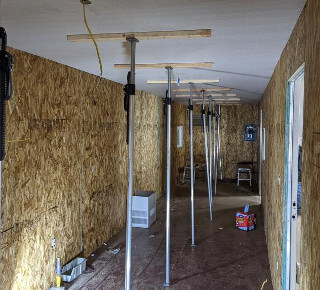
Now it's time to cover the inside with OSB boards "Oriented Strand Board" starting with the ceiling again then the side.
All the two by four framing studs are spaced 48 inches center to center so we have to make only one cut for the OSB board to fit in place except for the cutouts around the doors, windows and electrical outlets.
The OSB gets secured to the two by four framing studs using 1-1/2 inch sheetrock screws. Then we seal all the gaps with industrial grade silicone.
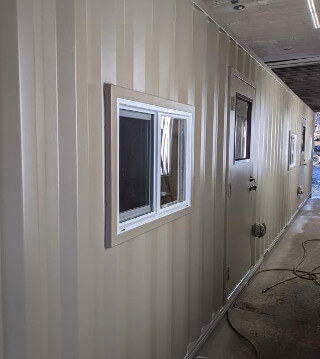
There is really nothing special about the windows or installing them. They came as a Weld-N-Go kit. The window is already inside the steel frame.
So all that needs to be done is slide the vinyl window into the frame and secure it with two self-tapping screws inside the right vertical track and two screws on the left track.
Then run a bed of caulking on the outside of the window to seal it up. We had to do this five times, as this shipping container office has 5 windows.
The only windows left are the ones that go on the doors. These glass windows get installed with a screw-on metal frame. The glass gets sandwiched inside the frame.
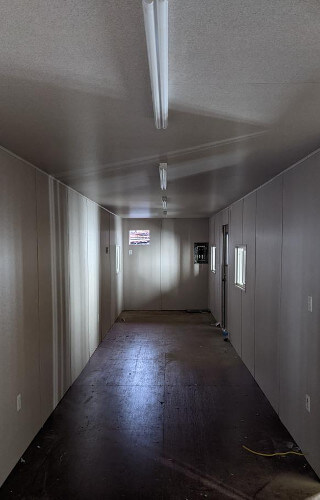
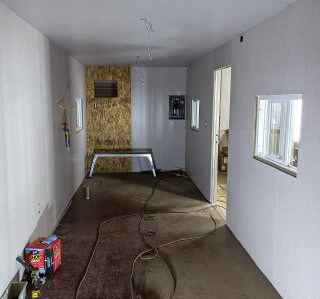
We used a light gray paper textured facing plywood to cover the inside of our shipping container office and that by itself brought day light to the inside of the office.
The sheets were cut to fit starting with the ceiling again and got fastened with liquid nails and some brad nails around the perimeter.
Scrap pieces of two by four were used with load locks to keep the ceiling textured facing plywood in place while the liquid nails dried.
The same thing goes for the sides too without the need of load locks. The liquid nails and brad nails were enough to keep the sheets in place.
You will end up with some small gaps here and there which is not a big deal and they will get covered when we start trimming the facing.
The one stressful part of this shipping container conversion to an office space was the inside facing. The reason was that the supplier sent us exactly the right amount of material to cover the 40-foot container and there was no room for errors in any cut.
At the same time we were on a timely schedule for the delivery of the offices to the customer. The facing supplier is in another state, so every cut had to be perfect or delivery would be delayed.
All that is left is trimming the inside walls, windows and doors. Then install the ceiling LED lights and outlets and slide the air conditioners in their openings.
Almost forgot about the flooring of this container office.
Only two days before the deadline for delivering these container offices to the customer location, we realized that there was no way for us to complete them on time and we needed some extra hands.
Luckily we found a local flooring contractor that was willing to work with us over the weekend to finish the laminate floor. By Monday morning the container offices were ready and on their way to the customer's location.
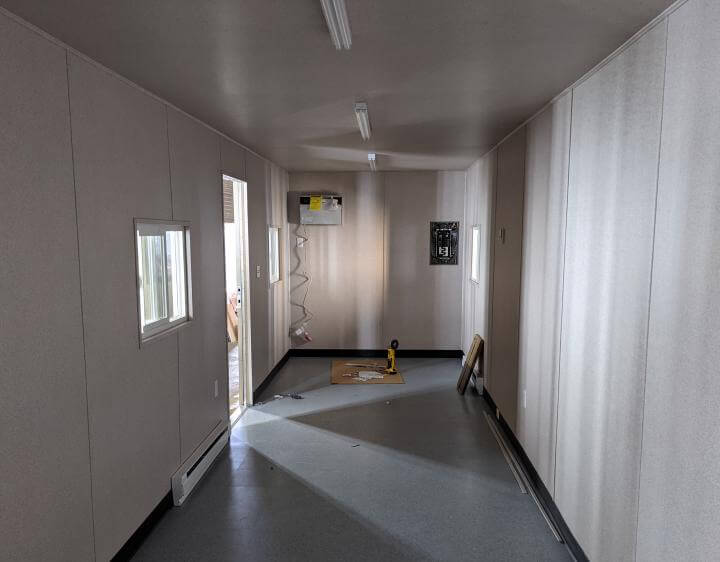
40ft Shipping container offices at location